Showing posts with label new medievalism. Show all posts

Wednesday, September 30, 2015

Jesuitical Psuedo Environmentalism - 'Fighting Westway' William Buzbee Georgetown University Law Center

to stop a tunneled highway that would have had portal pollution hot spots highlighting the need for cleaner automobile technoligies


I was one of the lawyers who represented the New York State DOT in this case. Mr. Buzbee reached out to our team a grand total of once while researching and writing this tome. His bias in favor of the plaintiffs is obvious, as is his lack of understanding of all of the issues. In short, the book is neither honest nor accurate, and I reject it as the sort of drivel that only encourages pseudo-environmentalists to litigate in order to block progress. - Bruce Margolius


https://www.youtube.com/watch?v=mp2iJxA5PO8


totally misrepresents the cost issues regarding the relative complexities of the Boston CAT project and Westway.

brushes aside considerations of engineering

feeds the myth of highways vs transit rather than transportation infrastructure versus things as the ruinous and wasteful drug war.
http://www.law.georgetown.edu/news/press-releases/professor-buzbee-authors-new-book.cfm

In his new book Fighting Westway: Environmental Law, Citizen Activism and the Regulatory War that Transformed New York City (Cornell University Press, 2014), Georgetown University Law Center Professor William W. Buzbee provides a history of one of environmental law’s most epic and renowned battles.

Buzbee uses archival documents and interviews with stakeholders to dissect the legal, environmental and political battles over Westway, the most expensive federally financed highway of its day and a project that would have involved massive landfilling in the Hudson River. It was a struggle that lasted 14 years, involving direct citizen protests and activism, Congress, presidents, agencies and several court trials. It pitted senators, mayors and the editorial boards of the New York Times and Daily News against scientists, federal agency staff and citizen activists and their lawyers. Buzbee uses the Westway battles to illuminate the strategies and elements of high stakes regulatory wars. Although many books have been written about the law, few illuminate the strategies and choices at play in common but complex high stakes regulatory conflicts that often involve society’s most fundamental political choices.

“Westway’s defeat remains shocking to its champions, especially considering the power of its supporters,” Buzbee writes. Although Westway’s defeat has often been described as an anti-democratic outcome over a mere procedural snafu, or lacking merit under the law, Buzbee reveals that Westway’s battles were over high stakes. The project’s defeat was not due to “some antidemocratic fluke,” he says, but to an effective combination of citizen activism, a highway versus mass transit choice, scientific input by expert regulators, environmentally protective choices in the law and judicial impartiality. While Buzbee surveys the entire history of the project, he focuses most of his attention on the legal and regulatory battles at its endgame, from 1982 to 1985.

“The dramatic story of the battle over Westway serves as a masterful case study of how today’s regulatory wars are waged across the United States,” says Richard Briffault, Joseph P. Chamberlain Professor of Legislation at Columbia University Law School.

And John H. Adams, founding director of the Natural Resources Defense Council, says: “Finally! The first thorough, truthful account of one of the great environmental battles of the twentieth century!”

Oh really?

The book spouts anti Westway ideas - doing so with full acceptance and utterly uncricticaly.


pp43-44

cites Lower Manhattan Expressway as precedent, yet disegards major differences between projects namely Westway's absence of the problems that politically plauged LOMAX.

- the former would have displaced numerous buildings
- would have been largely elevated or an open trench

Westway would have displaced non, asides from some piers that would be demolished anyway
Westway was primarily in a tunnel encasing noise and pollution

DEVELOPMENT

cites Westway opponents scoffing at Westway benefits regarding development

- ignored reality of greater property values when major road corridor is buried ig 96th street where the rr goes underground

- ignored the extra development of the landfill new development

- ignored added neighborhoods and property taxes- perpetual benefits

- ignored reconnecting Manhattan to waterfront via placing main stream of vehicular traffic in tunnel.

- ignored reality that Westway would replace existing freeway link with antiquated design connecting existing freeway segments


 LANDFILL- STRIPPED BASS

- ignored context of historically expanding landfill and that the concentration owed to a sewer outlet

- thus Westway would merely pushed fish a few hundred feet

- ignored efforts elsewhere to mitigate via providing alternative hatcheries in area.


Tuesday, October 7, 2014

Rockefeller Foundation Forgets Trucks With Push Against 12 ft Lanes


A new push against 12 foot wide lanes, calling for vehicular traffic lanes to be narrowed to 10 feet.

 http://www.citylab.com/design/2014/10/why-12-foot-traffic-lanes-are-disastrous-for-safety-and-must-be-replaced-now/381117/

Sobered by my now palpable failure, I have steeled myself for the task of explaining here, in a manner that can never be disputed or ignored, why the single best thing we can do for the health, wealth, and integrity of this great nation is to forbid the construction, ever again, of any traffic lane wider than 10 feet.

Is authored by Jeff Speck, AICP, LEED-AP, CNU-A, Honorary ASLA - a city planner and writer based in Washington, D.C., and author of, Walkable City: How Downtown Can Save America, One Step at a Time, which was the best-selling urban planning title of 2013.

It assumes a safety advantage of narrower lanes upon an assumption that people will necessarily drive sufficiently slower resulting in lower speeds when pedestrians are hit.


It makes no mention of trucks or emergency vehicles.  Nor buses.

It is funded by the  Rockefeller Foundation, furthermore indicating that entity's disregard for common sense and beholdence to neo-feudalism.


http://cos-mobile.blogspot.com/2014/02/what-about-trucks.html

Tuesday, November 12, 2013

Another doctrinaire production against urban freeways ignoring basic design and routing issues


Norquist- "it's hard to design..." "grade separated' highway's don't belong in cities- anymore then multi-level structures- have everything on a single level, like a ranch house.

He's with the organization Congress for New Urbanism, cloaks a more doctrinaire stance against urban freeways initially via discussing such that are elevated- from their web site:

America's twentieth century highway building era included elevated freeways which cut huge swaths across our cities, decimating neighborhoods and reducing quality of life for city residents. This massive concrete infrastructure had devastating effects on urban economies. It blighted adjacent property and pushed access to basic amenities further out. With the Federal and State Departments of Transportation confronting shrinking budgets and cities looking for ways to increase their revenues, it is an ideal time to offer less expensive, urban alternatives to the reconstruction of urban expressways.

New York City, Portland, San Francisco, Milwaukee and Seoul, South Korea have confronted this problem by replacing elevated highways with boulevards, saving billions of dollars and increasing real estate values on adjacent land. The Congress for the New Urbanism (CNU) believes that teardowns offer an attractive option for cities struggling with aging highway infrastructure. The strategies are proving themselves in adding value and restoring urban neighborhoods decimated by highway construction.

That this organization slips in Portland - involving the essentially surface level Harbor Drive -- with these other cities referring to *elevated* freeway removal, is but a hint of this agenda, hinted at by its cry for 'less expensive' alternatives against the broader political prioritizations- e.g. Pentagon, domestic surveillance and the drug war/cigarette-pharm criminal mercantilism, while of course neglecting the freeway benefits altogether rather then attempt any true cost benefit analysis.

This video does the same thing: its start with showing elevated freeways with unattractive underside environments, before then showing below ground level and surface freeways as examples to of its freeway elimination program.

It cuts to a man talking about the freeways in Buffalo, N.Y., particularly that which blocks the view and/or access to the waterfront, as the video then cuts to a shot of the below ground level Kensington Expressway. Its a project I don't yet see on his organization's web site, but which is being nonetheless so targeted by various entities, such as this. Accordingly this expressway built as an uncovered -- but for some cross streets -- trench via the right of way of the previously there existing Humbolt Parkway -- has already been proposed by local community groups to be reconstructed with a lid- essentially as a cut and cover tunnel beneath a new linear park to essentially restore the Humbolt Parkway. NYSDOT has two basic proposals, one for such a linear park somewhat elevated, the other for such as street level, with the existing trench deepened, as the clearances are deficient by about one meter, for accommodating larger trucks.

The Reclaiming Our Community Coalition is proposing that a cover be built over a portion of the Kensington Expressway complete with trees, shrubs and flowers. This project would restore the visual quality and natural environment of the Humboldt Parkway neighborhood by recreating Humboldt parkway over the section of Route 33 from east Ferry Street to the Best Street exit. This project would promote an aesthetically pleasing physical connection across the existing below-grade expressway, reuniting communities. In implementing this project, it should be noted, there would be no impact on existing traffic patterns.

In sum, this project would restore the treasure envisioned by Olmsted. A majestic tree-lined parkway would be restored which would improve the looks, health and benefits of the neighborhood. Specifically, with regard to looks, it would: return the beauty and elegance of the parkway; change the aesthetic perception of the community; and affect the curbside appeal thereby encouraging investment and attracting potential home-buyers. Regarding health, it would improve air quality and impart all the benefits of trees and green space. And, in terms of benefits, it would: stimulate the repair and improvement of existing structures economically, which would appreciate property values in a real way; stimulate commercial interests in the community, monetarily restoring needed vitality; highlight the City of Buffalo as the city of solutions for improvement; and show the community’s children the possibility of a better way of life.

Retaining the trench for a new tunnel would place the least amount of vehicular traffic directly in front of the houses facing this Humbolt Parkway-Kensington Expressway corridor- a factor leading to its support. The Norquist freeway removal doctrine of conversion to surface level boulevards is being promoted here - filling in the existing already paid for trench excavation -- for the sake of instead here placing an 8 lane surface boulevard.


http://www.nmgonline.org/Tools/Status/frontend/item.asp?type=0&size=0&lngDisplay=0&jPageNumber=1&strMetaTag=


“Having through traffic not have to slow down through town should not be a priority for the City of Buffalo,” Norquist says. “It hasn’t done Buffalo any good to have that criterion. If the objective of the expressways was to eliminate congestion, they worked perfectly, because congestion is not a big problem in Buffalo—not just traffic congestion but money congestion, people congestion. Everything’s been decongested because of this narrow objective of fighting congestion.”

An expressway, he says, is a rural form that doesn’t belong in the city. Few European cities have expressways within their city boundaries. Vancouver, which has some

Read more: http://artvoice.com/issues/v9n9/bury_this_big_mistake#ixzz1MaDvctDD

Norquist is being quite disingenuous- confuses rural form with urban form how many rural freeway have such retaining walls?

Norquists ends by dismissing the concept of grade separation- a dismissal that would include Washington, D.C.'s traffic circle under-pases, as that beneath DuPont Circle.

That 'greens' would support the travesty of filling in already paid for ground cuts, while altogether neglecting the issue of ramp design - aka center rather than side loader access ramps - belies an ideo-idiotology favoring depopulation over innovation - speaks volumes about what the so called environmentalist groups are really all about; a disgusting elitist contempt for commoners.

Tuesday, May 3, 2011

Streetsblog Pretends there are too many new vehicular road projects

Where the highways are not simply falling apart, but most were never even built.

http://dc.streetsblog.org/2011/05/03/mayors-rebel-against-state-mandated-highway-expansion-fight-for-transit/

“but the fact of the matter is when you look at how our dollars are deployed at the state level they’re deployed in a fashion that is inconsistent with where jobs are and where the economy is created.” That was fine was the U.S. was the world’s incomparable economic superpower, but we need to be more thoughtful with our spending these days, he said.

Beware these foundations from Washington, D.C., Manhattan, nor San Francisco, that claim that we have too many new urban road projects- they are about keeping the roads away from key properties and promoting the myth that there are no alternatives to petro via the 'white van' scapegoating of freeways- all for the devious distraction embodied in the above quote, from the obscene spending on the military and upon cigarette pharama mercantilism (the criminal drug war).

If they are that out of touch with reality regarding their locality, how can they continue to gather so much trust?

Granted there are many gullible college students ...

Thursday, February 17, 2011

Anti Car is Anti Transportation

Anyone writing that they are against "Cars" is against transportation for just about everything, and a hallmark of the sort of brain dead group reaction where sloganeering substitutes for rational independent thought.

-------------
http://www.thefreedictionary.com/car

car (kär)
n.
1. An automobile.
2. A vehicle, such as a streetcar, that runs on rails: a railroad car.
3. A boxlike enclosure for passengers and freight on a conveyance: an elevator car.
4. The part of a balloon or airship that carries people and cargo.
5. Archaic A chariot, carriage, or cart.

--------------------------------------------------------------------------------

[Middle English carre, cart, from Old North French, from Latin carra, pl. of carrus, carrum, a Gallic type of wagon; see kers- in Indo-European roots.]

The American Heritage® Dictionary of the English Language, Fourth Edition copyright ©2000 by Houghton Mifflin Company. Updated in 2009. Published by Houghton Mifflin Company. All rights reserved.


--------------------------------------------------------------------------------
car [kɑː]
n
1. (Engineering / Automotive Engineering)
a. Also called motorcar automobile a self-propelled road vehicle designed to carry passengers, esp one with four wheels that is powered by an internal-combustion engine
b. (as modifier) car coat
2. a conveyance for passengers, freight, etc., such as a cable car or the carrier of an airship or balloon
3. (Transport / Railways) Brit a railway vehicle for passengers only, such as a sleeping car or buffet car
4. (Transport / Railways) Chiefly US and Canadian a railway carriage or van
5. Chiefly US the enclosed platform of a lift
6. a poetic word for chariot
[from Anglo-French carre, ultimately related to Latin carra, carrum two-wheeled wagon, probably of Celtic origin; compare Old Irish carr]


-----

Sunday, October 31, 2010

New Haven CT Funny Handshake on Rt.34 Giveaway

Outgoing U.S. Senator Christopher Dodd flanked by New Haven Mayor and Congressman making fools out of themselves with the Route 34 Giveaway.

See more at:

http://www.nhregister.com/articles/2010/10/16/news/new_haven/doc4cb931277aa4d627218579.txt

Thursday, March 4, 2010

Route 34 Giveaway Continues


New Haven elitist driven Mayor continuing his mission to subvert transportation so a few developers -- such as big pharm Pfizer which took the right of way for a $1 sweetheart land deal -- don't have to pay for the beams for their buildings to span rather then fill New Haven's below ground level Route 34 freeway


According to an article in the New Haven Independent:


The developer is Carter Winstanley.


The name of the project is 100 College Street.


It will close the segment of the route 34 freeway with its exits 2 and 3.


The Mayor intends to take this to the New Haven alderman for their approval sometime in 2010, with ramp demolition starting in late 2010 or early 2011.


This has already received $5 million in Federal funds, plus State of Connecticut approval, and is awaiting a decision upon a request for $40 million in stimulus funds.


Public response to this, from the comments section to this article, appears to be growing more negative then that to such right of way blockage projects to te west of the Air Rights Garage, given its application to an existing segment of highway.


posted by: Our Town on February 2, 2010 9:29am

To all of you who may think this is a good idea (removing Rt. 34), good luck to you getting around in New Haven in the future. This “re-knit the city” jargon is crap. Johnny is blindly pushing ahead without a care about how it will work. Even with the highway in place and without the development, there is gridlock in this area daily. Now we’re building more in this tight corridor adding thousands of trips, and we’re going to reduce capacity to serve it. Gateway College alone will overwhelm the street system. There is no transit component to this. There will be MORE cars on WIDER streets around the hospital. I just hope some of the “traffic calming” groups see through this and realize that conditions around the hospital will get worse, not better. Build over the highway. DO NOT REMOVE IT. You will regret this if it is built as planned.


posted by: Pioneer on February 2, 2010 11:08am

It is not wise at all, as Our Town said to remove Rt. 34. This isn’t so much of a highway to nowhere as everyone thinks. It connects downtown and the highway to Westville, Edgewood, Whalley, yadyyadyaya. It is always crowded, it cannot be removed. This road must stay, somehow. So while we are tearing up the highway and we’ve got a big hole, lets fill it! Lets put a tunnel going from where Rt. 34 will leave off, going to the other end, towards the other end where it will leave off.


posted by: Scot on February 2, 2010 12:43pm

I love the idea of reconnecting those parts of the city and having a nice-looking, pedestrian friendly way for people to walk around. Also love the idea of building some new office space and residential to increase tax revenue and make it more vibrant. First and foremost I want the city to be walkable and safe. That said, I’m also realistic and realize many people commute, and we need to accommodate cars, bikes, and buses too. The idea of building over the corridor, and creating a tunnel sounds logical, as long as it could be done attractively. You could build almost anything you want over the tunnel -walkways, a park, condos, offices, etc. People needing to drive from across town to the interstate can zip through without endangering any pedestrians. A tunnel would actually remove a lot of cars from the walkable parts, rather than just slowing them down. Does anyone know if the city is looking into that? Of course if they have other plans that could truly accommodate the traffic without a tunnel, even better. But definitely dont want more gridlock, which creates more smog, etc.


posted by: westviller on February 2, 2010 5:25pm

While I appreciate the Utopian sentiments of those who want to do away with rt. 34, we cannot simply ignore the prospect for gridlock that these plans create. The potential for even more impediments to access to YNHH is not just a philosophical matter about privileging automobiles or bikers/pedestrians. It is a public safety issue. Any plan to redesign this corridor must absolutely assure that emergency access to the hospital is not impeded. I have not seen a word in any of these discussions about this public health issue. Apparently, it is okay for patients to die in ambulances stuck in traffic, as long as we have nice bike lanes and the cars all move slowly, if at all.


posted by: Chris O on February 2, 2010 9:22pm

Boston downtown (I93?) works fantastically well in the tunnels exiting onto pedestrian oriented streets with ground level retail. Keep 34, fill the side, build over it and give us a tunnel. Tunnels, bridges and cities go together. We need higher density in the city and this is the right place. Over the next century the city will probably grow in two directions from downtown; South to the Harbor( Longwarf) and North of YNHH along 34 to and along the Boulevard. We need to build a smart network of roads to handle traffic volume and easy and expensive parking.


posted by: Joe H on February 2, 2010 9:47pm

What is it? New Haven doesn’t have enough vacant land, so it’s forced to incur expensive projects and build over an existing highway?????
What about the former site of the Colosseum?

I think it’s a major mistake messing with the current Route 34. It will tighten a major artery into the city and limit options in the future. The city should have continued the highway under the air rights garage and under the Pizer building. It would have alleviated some of the traffic congestion. But it’s too late for that now. Don’t make another mistake. Bridge to the Hill neighborhood? Big woop-de-doo?!

Sunday, July 6, 2008

Jesuitical Tri State Transportation Campaign Against Extending NJ Tpke Truck/Car Lanes


- Assumes that slowed growth is permanent;
- Argues that project to extend separate car/car-truck lanes southward to I-276/future I-95 a 'dinosaur'
- Says nothing of improved safety of extension, nor new technologies that would stem gas price increase induced decreases in traffic growth.

http://www.tstc.org/press/2008/061108_NJT_data.html

Tuesday, July 1, 2008

Jesuitical New Medievalist/Neo Feudalist "Environmentalism"

Ignores the differences in types of biofuels, as if the inefficiencies of corn based fuel negates the entire concept of biofuels

Ignores electric propulsion
untethered to a 3rd rail; Assumes everyone can just live closer together

Dismisses innovation; Presumes massive population depopulation

A letter to the editor in The Washington [a]Post[ate]

http://www.washingtonpost.com/wp-dyn/content/article/2008/06/17/AR2008061702291.html

"A Better Route Than Biofuels"

Wednesday, June 18, 2008; Page A14


Vinod Khosla ["All Biofuels Are Not the Same," op-ed, June 16] missed a critical point in defending biofuels. Instead of trying to find "good" biofuels, we should be asking "why biofuels at all?"

Investment in biofuels yields fewer returns than investment in transportation alternatives. The renewable fuels standard that Congress passed in December, in combination with generous tax credits, provides $188 billion for biofuels. This will reduce U.S. petroleum use by less than 10 percent and could potentially offer little to no reduction in greenhouse gas emissions, because 13 billion gallons of corn ethanol are exempt from the law's greenhouse gas standards.


Devoting these subsidies to public transportation and smarter growth would do much more to reduce greenhouse gas emissions, fuel use and costs to consumers. But big oil companies have thwarted such solutions. It is time to take control of mobility out of the hands of wealthy corporations and entrepreneurs and put it into the hands of the people.


KATE McMAHON

Energy and Transportation Policy Campaigner

Friends of the Earth

Washington


"Friends of the Earth" is one of the many Jesuit Order run "environmentalist" organizations that reflexively oppose roads without traffic lights, and which apparently omit any support for linear parks, such as Washington, D.C.'s aborted South Capitol Mall.

The Washington [a]Post[ate] closed this letter's comments after receiving only three.

The writer is right - corn is not a proper source for bio fuels. But ethanol from cellulose may work. let the market decide. The predicted cost for cellulose ethanol is under $1.50 a gallon. If this is true, it will be a natural. But themarket should decide. It is compatible with the modern IC motor and not as much of a hazard as hydrogen. True, it makes CO2. But that has yet to be proven a bad element in our air.

6/18/2008 7:52:22 PM

Look at the construction of cities throughout the world. Only in America do we have far flung suburbs making walking or mass transportation impractical. we need to rethink the way we grow our cities and towns. These alternative fuels etc will do us little good unless we rethink the way we live.

6/18/2008 6:11:35 PM

TwoEvils wrote:

Ethanol is a ridiculously poor fuel, requiring huge amounts of energy to create and returning much less energy (mpg) than an equivalent amount of petroleum-based gas.

Biodiesel, on the other hand, does not require nearly the energy input to create and has much more energy per gallon. It can be used in any diesel vehicle often with only minor modification, and will be especially valuable to the trucking industry which is suffering extremely high fuel costs.

There's a reason Europe stuck with diesel instead of gasoline. There's a lot more energy (mpg) in a gallon of diesel than in a gallon of gas.

6/18/2008 11:16:44 AM

Friday, May 9, 2008

Transportation Corridor Chocking- Un-built I-95 Washington, D.C. Red Line

http://wwwtripwithinthebeltway.blogspot.com/2008/05/cuabrookland-transport-corridor-chock.html

Although the US government after 911 paid lip service to the idea of additional evacuation routes, they now want to chock Washington, D.C.'s sole north-south express ground transportation corridor.

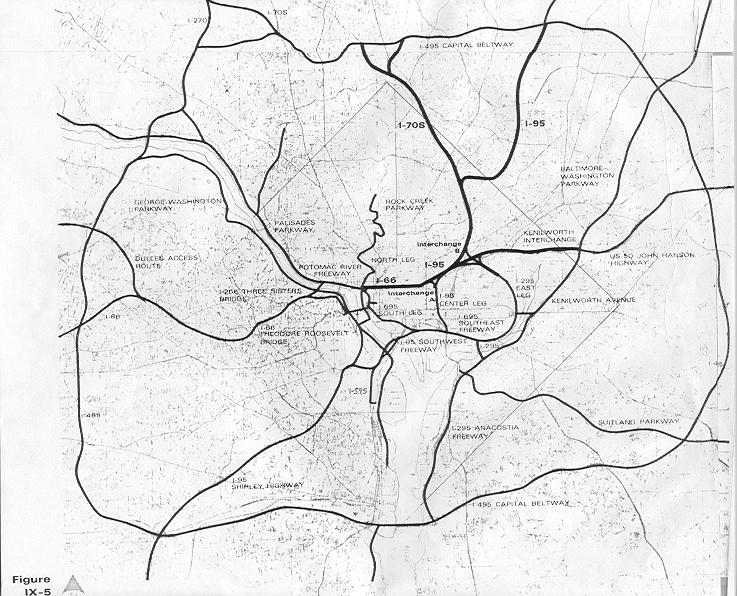
Washington, D.C.
1971 proposed freeway network
the un-built North Central Freeway -- the sole north-south route --
along today's surface WMATA Red Line railroad corridor
midway between Beltway and Potomac River


That same transportation corridor
proposal for a chocking
next to the Catholic University of America

Tuesday, April 29, 2008

An 'Easy' Way to Waste Time

From a letter to the editor in the April 28, 2008 edition of The New York Times

“The Big Thirst” (Week in Review, April 20) left me gratified, mystified and frustrated by turns.


Gratified because as a bicycle commuter, I am apparently the rarest of commuting Americans. And most efficient, in terms of energy per passenger mile.


Mystified and frustrated because the energy expert Vaclav Smil’s “... Or Conserving It” graphic describing three strategies for conserving oil doesn’t mention the strategy that can be enacted immediately with absolutely minimal implementation cost. What is this mysterious and apparently obscure strategy? Drive the speed limit.


The impact on the fuel economy would be even greater if the speed limit — gradually raised by increments since being set to 55 miles per hour in the late 1970s — were reset to 55. And if observing the speed limit were considered a public benefit instead of a public nuisance.


Consider the costs — in dollars, lives and security — of impatience.


Robert F. Anderson

Ellicott City, Md., April 20, 2008


Apparantly some think that time is not money.


By this logic, I should take 60-90 minutes to bicycle to work rather then 14 minutes to drive.

Or we should drive clustered together at 55 mph rather then 65-75 mph more spread out with greater reaction time between vehicles on limited access highways that lack pedestrians and side streets, despite the advances in vehicular technologies that provide greater fuel efficiency. In the early 1990s in a research paper that I did for a class at the American University in Washington DC on traffic clustering, I found that the ratio between single and multi-vehicular accidents was roughly 40/60 with the 55 mph national maximum speed limit, shifting to roughly 60/40 with its repeal. Hence the lower speed limit had a greater proportion of multi vehicular accidents: the type more likely to involve non at fault drivers; with the higher speed limits having a lesser proportion of those and the greater proportion of the single vehicular accidents that by their very nature likely involve only the at fault driver (and any passengers in that vehicle).

This will save even less fuel given the propensity pf police officers to set speed traps on downgrades, causing drivers to ride their brakes rather then pick up some free gravity speed/momentum.

Nonetheless, at least one of the current 3 major party candidates for U.S. President favors a return to a 55 mph speed limit: Hillary Clinton.


Sen. Hillary Clinton's Untimely Proposal
Hillary Clinton Backs Return to 55 mph speed limit
Hillary Clinton pushes for reinstatement of national 55 mph limit


How many Hillary Clinton supporters -- particularly the lower level income people that she allegedly reaches out to -- know her favoring reimposing the 55 mph national maximum speed limit?


Drive 55- No New Technology


Monday, April 28, 2008

The "Tri-State Transportation Campaign" Apparantly Looses It

A beautiful thing about the internet is its ability for people of differing opinions to communicate openly.

The "Tri State 'Transportation' Campaign" (TSTC) has an article about a real estate development/right of way violation scheme for New Haven, CT's Route 34 freeway: a short spur from the I-95/I-91 interchange that crosses over a railroad corridor before dropping down to pass beneath several cross street overpasses and truncated beneath an Air Rights Garage that as its name implies, respects this segment of below grade freeway. A right of way for this freeway's unbuilt segment continues further west to West River Memorial Park, where the freeway extension was to rise up as an elevated structure to cross over as a bridge, with earlier plans having the western continuation as a divisive earthen berm through the Horseshoe Lagoon- an area near the Yale University Athletic Center. Later plans deleted this westerly extension, and would have continued the freeway for only a few blocks as a below grade facility to rise up only to connect to the existing surface street, North Frontage Road. However, that would be blocked by the sale of the already cleared right of way, with Pfizer placing a $35 building immediately to the west of the Air Rights Garage, irresponsibly without a platform to preserve the freeway extension's subterranean right of way. This Pfizer building is envisioned as the first of a series of new buildings to be so constructed upon both the unbuilt extension's right of way, and upon the existing below grade highway- not as platforms, but rather by dumping tons of dirt to eliminate this highway and to relocate its traffic upon the existing parallel service roads.

To their credit, the TSTC article has a comments section, which I used (excerpts below)

#5 Douglas Willinger
Posted April 21, 2008 at 7:46 pm | Permalink

The positive benefits sought can be achieved via new buildings that respect the Route 34 freeway’s subterranean right of way.

What was done with the Pfizer building fiasco should not be allowed to hold this public right of way hostage.


#6 Chris H
Posted April 27, 2008 at 9:03 pm | Permalink

Douglas,


I don’t know if you are going to check this because it was awhile ago but experience has shown that your scenario hasn’t really played out in practice.


#7 Douglas Willinger
Posted April 28, 2008 at 11:17 pm | Permalink

Chris:


The plan adds large buildings that will attract people. These are far larger buildings then those displaced by the freeway decades ago.

Are these buildings to be all mixed use, with most or all of the people having both their residences and jobs in these buildings?


I then check out the link in #6 , "From Induced Demand to Reduced Demand" by Charles Siegel, before attempting to make the following post:

Chris:


Your link talks about under-grounding existing freeway corridors via complete reconstruction, such as Boston's Big Dig.

But it says nothing about the far, far easier and inexpensive task of constructing platforms over existing below grade freeways.

I looked forward to an enlightening discussion/debate. For instance the Siegel article states:

In Great Britain, where there is a very active anti-freeway movement, transportation planners are no longer allowed to count reduced travel time as a benefit of building a new freeway. The Department of Transport has adopted a guidance document saying that cost-benefit studies on new freeways must assume that elasticity of demand may be as high as 1.0 with respect to speed - which means that average trip length increases as much as speed increases, so building freeways and increasing speeds just lengthen trips and does not save any time.2

Interestingly, this anti freeway movement lies to itself and others by prohibiting a consideration of time savings, instead submitting to a parochialist doctrine against allowing people a choice to travel further increasing choice over such things as jobs.

I write attempting, because the TSTC comments page then refuses to allow this to be posted, giving me a single word message:

discarded

Apparantly someone at the TSTC site could not handle this discussion.


Thursday, April 24, 2008

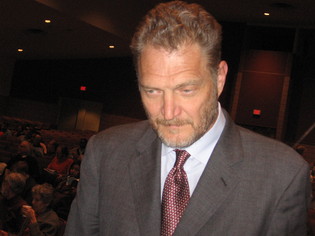
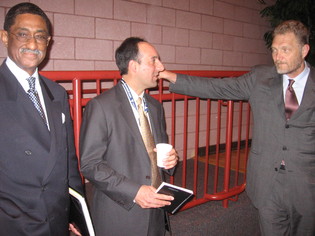
Yale's Parochialist Messiah John Norquist'

Norquist, a proponent of removing unsightly locally divisive elevated urban freeways, was recently in New Haven calling for removing that city's Route 34 Oak Street Connector: a below-grade freeway which opened in 1959, and since truncated beneath an Air Rights parking garage, but with a cleared right of way -- asides from Pfizer's 2005 demolition special -- extending to just before the also uncompleted West River Memorial Park, initially created as a WW1 monument to be lined via promenades.


"I [John Norquist] Say, 'Tear It Down'"

by Allan Appel | April 17, 2008 1:10 AM | | Comments (13)


nhi34%20002.JPG


John Norquist tore down a “connector” in Milwaukee more than twice as long as New Haven’s lamentable Mayor Richard Lee Highway — and a viable and prosperous streetscape arose in its place. He came to New Haven to tell us how to do it.

More than 100 people came to the Career Regional Magnet High School auditorium Wednesday night, many thinking they were there to hear from a kind of transportation messiah. As with messiahs in general, Norquist, who served as Milwaukee’s mayor from 1988-2004, didn’t bring many details, but he did provide hope.


Calling the Route 34 connector, the “Disconnector,” Norquist also provided some concrete advice: “First, don’t contemplate the project to death. It’s not going to be extended, it doesn’t justify itself by carrying much traffic. So get on with it, build the pressure, and get it done, so it can be an example to other cities, especially Hartford.”


Mayor John DeStefano wants to build over the Route 34 Connector and redevelop all the land once planned for an extended highway there.


But a co-speaker of Norquist Wednesday night, state Deputy Transportation Commissioner Albert Martin said the removal of Route 34 is by no means a done deal with his department.


Speaking with consummate diplomatese, he said, “Governor Rell’s vision of livable communities calls for an objective study of the removal of 34 to see if it’s in the best interest of New Haven.”


“I say tear it down,” Norquist replied in his remarks. “The state built it, let the state get rid of it. If you want to be nice, maybe the city can pay for the utility reconnects. But otherwise, not a dime.”


nhi34%20003.JPG


He also advised that the road should be taken down as close to I-95 as possible. “Get those off ramps tucked right next to the highway,” he said, “the way it’s done on the Dan Ryan Expressway in Chicago. So that when you get off the highway as soon as possible you’re on a viable urban grid of small streets.”

Except perhaps for Martin, Norquist was preaching to the choir about the removal of 34. It was the nature of the new space to be created, that viable urban grid to follow the removal, that was really on the minds of the audience members.


“I didn’t come here because I needed convincing to take down 34,” said East Rock Alderman Allan Brison of the Green Party. (Only two other alders, Dwight’s Gina Calder and Fair Haven’s Erin-Sturgis Pascale, were present.) “I hoped to hear what’s going to go in there. From what I heard from the city at previous meetings and the current construction makes me think it’s going to be high-end tall buildings with lots of parking.” ...


More than 100 people came to the Career Regional Magnet High School auditorium Wednesday night, many thinking they were there to hear from a kind of transportation messiah. As with messiahs in general, Norquist, who served as Milwaukee’s mayor from 1988-2004, didn’t bring many details, but he did provide hope.

Posted by: Our Town [TypeKey Profile Page] | April 18, 2008 12:41 PM


Beware false prophets. They talk of destroying one true transportation corridor without thought of how all that traffic will get around, just, it will be absorbed by the grid system. They talk of replacing the highway with buildings in "scale" with their surroundings. They talk of trolleys, but don't want to build to the density that would actually support a trolley system.


This is all poorly thought out. Give me an alternate transportation plan before you start tearing out a major transportation facility.


Some here forget that Rt. 34 is part of a regional system, it's not just for New Haven. Every city could say get your road away from here, but we all rely on the system, and we need to look beyond our parochial interests and see the big picture.


All I can say is that I don't want any of those 80,000 cars a day coming down my street. That's why the Rt. 34 highway was constructed in the first place. All that traffic was on Chapel Street and George Street. And now there's even more. What a relief to the neighborhood was Rt. 34 when it was connected along the frontage roads...Have we forgotten?


Posted by: robn | April 17, 2008 8:57 AM


The Urban Design League needs to show how the daily I-91 traffic back up on the connector (something that Mr Norquist obviously hasn't bothered to examine) is going to be absorbed by that exit. Its completely unacceptable for that exiting to be absorbed into the East Rock neighborhood, where there is already too much traffic. Unless viable, high volume exiting is provided in the current connector location this idea is dead on arrival. Alderman Brison should acknowledge this problem because if he doesn't he is going to be a one term alderman.


Posted by: Webblog 1 | April 19, 2008 3:19 PM


How much was Norquist paid to come to New Haven and say something stupid like:


"If you mean affordable rents," he responded, "the head of our city council, an African- American, said that affordable rents should not be a goal in life."


"Unaffordable rents should be. He meant of course that people do so well, they can afford more. I wouldn't worry about it. Then again, I'm not that familiar with New Haven."


Obviously Norquist didn't do his home work:


According to a NHI article Re: "Pilot Hike Back on the Table"


Forty Seven thousand (47K) New Haven residents qualify for federal Earned Income Tax Credit, that's 47K of 92K persons above the age of 18, with a family of four earning less than 40K a year. (Source U.S. Census Bureau). Almost half of New Haven's residents rely on the so called affordable rent.


Therefore, Vanessa Burns, representing State Sen. Toni Harp, asked Norquist to comment on how the post-highway removal gentrification in Milwaukee affected local minority communities.


This was an entirely appropriate question.


Posted by: robn | April 20, 2008 1:51 PM


This is a stupid idea and I'll reiterate that anyone who thinks its a good one should drive down I-91 into 34 during rush hour and observe the volume of traffic. There is NO WAY that this can be instantly absorbed into a slow city grid without backing up traffic and causing drivers to dump into East Rock.


There is plenty of developeable area beyond Phizer and the reason that rt 3d dempo is being discussed is becuase its a classic triple dip...federal pork barrel funding for road demolition as well as road re-building and surrounding redevelopment.


How about just simply develop where there isn't a major vehicular artery?


Or, just simply build upon platforms to preserve the Route 34 freeway and extension's subterranean right of way to get the benefits of both the freeway and the new real estate development.


More than 100 people came to the Career Regional Magnet High School auditorium Wednesday night,
many thinking they were there to hear from a kind of transportation messiah. As with messiahs in general, Norquist, who served as Milwaukee’s mayor from 1988-2004, didn’t bring many details, but he did provide hope.

“I didn’t come here because I needed convincing to take down 34,” said East Rock Alderman Allan Brison of the Green Party.

It's already "down" as its a below grade highway.

Obviously sloganeering here serves as a substitute for independent thought.


Monday, April 21, 2008

Yale and Pfizer's Transportation Treason

Ripping off the public right of way;
New Haven, Connecticut Route 34 Connector

http://newhavenindependent.org/archives/2007/06/what_will_happe.php

Posted by: Our Town [TypeKey Profile Page] | June 19, 2007 3:10 PM


I really don't get it. You concentrate economic activity to the downtown area and the Route 34 "Corridor", and then you restrict access to the area by choking its main artery? Let's not be silly. We do not have alternate transportation; we do not even have near the population density to support mass transit without massive subsidies (a much larger subsidy than required for the roads). You talk of pedestrians and safety, and I can think of nothing safer than keeping the vehicles away from the people in limited access cuts or covered roadways. Just think, a limited access roadway can handle approximately 1200 cars per lane per hour, a surface street can handle about 600 under ideal conditions. You need twice as many surface lanes for the same amount of traffic, and that traffic which now moves at a steady flow would have to start and stop at traffic lights, a major source of air pollution. Pedestrians that now cross the Rt. 34 roadway on bridges would now have to cross twice as many lanes in a crosswalk.


If the purpose is to reduce the traffic in the "Corridor", which is not what a developer wants to hear (one of the comments about Yale's purchase of the West Haven site was "Access to I-95"), where will the traffic go? Onto an adjacent local street, exacerbating traffic conditions on those nearby streets to the point of gridlock? Or maybe not come to New Haven at all, as Yale has shown us with their West Haven site.


This isn't an issue of cars vs. pedestrians and bicycles. Cars and trucks are and will be the transport of choice for a long time. It is safer and better for pedestrians and bicycles to keep as many cars and trucks as we can off the local streets. This idea that a "Boulevard" is more pedestrian friendly than an expressway is a crock.


The problem with Route 34 is that Henry Fernandez and JD gave it away to Pfizer when they didn't demand that their building be built on a platform, and JD has now let Yale build in the Rt. 34 right-of-way also. Now JD is cramming Gateway College into the mix, Yale is continuing to build, and the Hospital continues to grow. All this traffic in two surface lanes...What ARE you thinking?


Posted by: nfjanette [TypeKey Profile Page] | June 20, 2007 1:20 AM


The problem with Route 34 is that Henry Fernandez and JD gave it away to Pfizer when they didn't demand that their building be built on a platform, and JD has now let Yale build in the Rt. 34 right-of-way also. Now JD is cramming Gateway College into the mix, Yale is continuing to build, and the Hospital continues to grow. All this traffic in two surface lanes...What ARE you thinking?


Thank God I've lived long enough to see someone else understand the problems with those decisions. If that one block next to the Air Rights garage had been built differently, the connector traffic could at least continue under the garage and surface up ramps into that block, or even better, the next block. Look at the snarled traffic in that area during any rush hour - New Haven traffic engineering at it's finest.


Pfizer's Demolition Special
Route 34- Kurumi Roads
Route 34 Right of Way Violation Scheme -
Tri State Transportation Campaign

Route 34 Right of Way Violation Scheme (more) - Tri State Transportation Campaign

New Haven Future Framework 2008 pdf
Route 34 Stump Aerial Photos

Saturday, March 29, 2008

Truck Strike Needed to Educate Elites About Importance of Highways

As exemplified by the movie "The Day After Tomorrow" Manhattan and D.C. elites have about zero understanding of road transport infrastructure, as if the food just appears in supermarkets like magic.

This strike regards fuel costs, but it really is needed to educate the elitists in places as N.Y.C.'s Manhattan and Washington, D.C. NW about their pathological-jesuitical "new urbanist" disregard of highway maintenance and expansion.

The strike is to be nation-wide, but since truckers like everyone must earn to live, the strike is only to last one week (April 1 - April 7).

A better approach would be a far, far longer strike that targets the areas of the wealthy elites: aka Manhattan below 116th Street and the entire NW area of Washington D.C. and its adjoining area inside the I-495 Beltway and northward to Potomac where significant elitists live.

Also, places as Bayville and especially Rye N.Y.

http://www.topix.com/forum/business/truck-drivers/TN8JSAN3IIVG779D9

http://www.worldnetdaily.com/index.php?fa=PAGE.view&pageId=60155#

Saturday, October 27, 2007

A Beholden Doctrine


From Urban Transport.org
Unfortunately, about 1975, politicians and planners began to embrace the idea that we were in an "era of limits" - the notion that there were "smarter solutions," that "we can't just keep on building more roads," that "transportation demand management" could help wean Californians off their irrational "love affair with the automobile" and into "modern, efficient, high-capacity mass transit."

Then-governor Jerry Brown's aides openly proclaimed, "Our job is to pry John Q. Public out of his car (and) to make life miserable for the single motorist."
http://www.urbantransport.org/sole.pdf

Jerry Brown, pictured above on the front cover of an April 23, 1979 issue of Newsweek magazine with the singer Linda Ronstadt, about mid way through his 1975-1983 service as Governor of the State of California; he has a long political career including service as Mayor of Oakland from 1998 to 2006, and in 2007 is California Attorney General. In 1976, 1980 and 1992 he unsuccessfully sought the Democratic nominations, and in 1982 was the unsuccessful Democratic nominee for the U.S. Senate.

Jerry Brown- Wikipedia
(excerpt)

Brown was born in San Francisco, the only son of former San Francisco lawyer, District attorney and later Democratic governor Edmund G. "Pat" Brown Sr. He graduated from St. Ignatius High School and studied at Santa Clara University. In 1958, he entered Sacred Heart Novitiate, a Jesuit seminary, intending to become a Catholic priest.

A Sampling of Attitudes Towards D.C. I-95