Saturday, October 29, 2016

D Willinger June 30, 1999 Comments Miller Highway Relocation


https://books.google.com/books?id=oaM1AQAAMAAJ&pg=PA353&dq=westway+highway+project+eis&hl=en&sa=X&ved=0ahUKEwjC56rDi93MAhXKRiYKHQUyDWYQ6AEIMjAE#v=onepage&q=westway%20highway%20project%20eis&f=false


Pp 175-177 MILLER HIGHWAY PROJECT June 30, 1999 public hearing transcript

Hello.  My name is Doug Willinger. I’m a Founder of the Takoma Park Highway Design Studio. Where I’m working on a web site to show the differences between community friendly

I ask a rhetorical question of the people here: Who hear likes Grand Central Station?  Who here would have been against building Grand Central Station early in this century?  Well, Grand Central Station was built upon the site of the original grand Central Station, which was only about 30 years old and had been rehabilitated in 1898 only 6 or 7 years, before they tore it down.  This is nothing new here.  This is about change for the better.

I am very dismayed to see people here arguing in favor of an elevated highway that if it were anywhere else they’d be opposed to it.  If they had it going all the way down to the Battery Park, they would be crying to tear it down.  We need to move ahead with this.  We need to stop giving in to the type of poor planning that actually had us not build this tunnel 10 years ago and we threw away a great opportunity on the West Side to build something that could have benefited everyone with the highway tunnel and with light rail on top.

If we really want to save money today, why don’t we suspend the current 9A project and restart it up with a surface-level trolley on top and a highway tunnel beneath, because we’re going to come to the conclusion [in] about 10 years to tear it up and do it again right.  Let’s do this project right as it’s being proposed and move ahead with it.

I suggest that a lot of the opponents here will be joining on top of that thing with supporters when it is done and saying, yes, this was good.  You’d be against Riverside Park.  You’d keep it an open rail yard with the types of arguments that we are hearing today.  Let’s move ahead and let’s move beyond the hysteria.  Thank you very much.

The authorities would not go ahead with this project in 1999, largely because the elevated segment of freeway this tunnel would replace, had been refurbished only about a decade earlier.

However, segments of this replacement tunnel were subsequently constructed starting about 2006, as such would be directly beneath the new southern extension of Riverside Drive alongside the Trump development, thus saving money in so far as avoiding having to tear up that area to construct the tunnel later.

Unfortunately that general idea was not adopted with the 9A 12th Avenue/West Street project which constructed an all new roadbed, which if it could not be delayed for a tunnel, should at least been constructed with the necessary sub-supports to allow the subsequent excavation for a tunnel, to avoid the waste and disruption of having to tear it up for such.


.

Saturday, September 24, 2016

Brooklyn-Queens RX


- Gowanus Tunnel Deferred for A Few Decades- existing viaduct being reconstructed

- Feds Deny BQE Tunnel that would provide useful extra capacity

- Proposals for IRT expansion languish

Best Bang For the Buck-

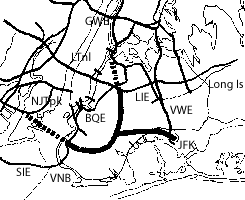
Construct Linear Park Covered Cut & Cover Tunnel Interboro-Cross Brooklyn Expressway/Cross Harbor  With IRT X Line via the New York Connecting RR Corridor


Reconstruction of underutilized RR 
into linear park atop multi purpose cut and cover transportation facility 
to better serve and connect the boroughs and the region


- Reconstructs existing under-utilized New York Connecting Railroad

- Constructs New Linear Park Atop Multi-Purpose/Railway-Expressway Cut and Cover Transportation facility

- Provides modernized-expanded freight rail, plus new IRT X Line from northern Queens southward to east-west through Brooklyn

- Provides an all new parallel vehicular route to the Brooklyn-Queens and Gowanus Expressways, avoiding construction disturbances to traffic upon those roads, and ultimately ease their future reconstruction, as well as better serve JFK Airport.

- Provide a much needed vehicular expressway route and IRT subway line across central Brooklyn

- Provides options for extensions:
-- westward via an all new Cross Harbor Tunnel,

-- northward via new tunnel connections to the Bronx,

-- eastward via IRT spur to JFK Airport.


Interboro Expressway was planned during the 1960s, included modernizing the existing IRT Carnesie line.

Cross Brooklyn Expressway was planned during the 1950s and 1960s to be routed by the Bay Ridge LIRR corridor, with different ideas for fitting it within the corridor's 80 foot wide middle segment, by the mid 1960s as a multi-level elevated facility, and by the late 1960s with multi-level cut and cover tunnels with new IRT line and new development atop, known as the 'Linear City' proposal.

IRT X Line is being promoted by the Regional Planning Association. It would run via the combined corridors of those previously planned for the Interboro Expressway and the western portion of the Cross Brooklyn Expressway, thus including the IRT line that had previously been planned as part of the proposed Cross Brooklyn Expressway-Linear City Project.

Both the Interboro and the Linear City Cross Brooklyn Expressway proposals were cancelled over 4 decades ago: the Interboro in 1973, and the Cross Brooklyn/Linear City in 1969 as part of then NYC Mayor Lindsey's mass cancellations of the city's yet to be built freeways.

This proposal would combine a revived Interboro and Cross Brooklyn Expressways with an IRT X line conceivably expanded to include a spur to JFK Airport, in a design building upon what was developed with the previous 'Linear City' proposal, with the concept of enclosing the Expressways and the Railroads within box tunnels, but with a continuous linear park.

It would start the Interboro at the New York Connecting Railroad junction with the I-278 approach to the Triborough Bridge, reconstructing that segment to create the new junction.

The Cross Brooklyn Expressway would be built to accommodate extensions to the west and to the east, respectively: a Cross Harbor Tunnel to I-78 in New Jersey, featuring vehicular expressway and rail lines (freight and IRT); and a Expressway and IRT continuation to JFK Airport, and beyond via the east-west portion of the Belt Parkway with added carriageways and decking, to the Sunrise Highway Corridor.

Provides new enhanced transport corridor facility via existing underutilized corridor roughly paralleling the existing BQE-Gowanus, without requiring any disruptions to that existing corridor-facility; and ultimately could accept traffic diverted from that existing corridor-facility to make the later reconstruction of such more practical.  It would be easier to eventually construct a tunneled replacement for the BQE-Gowanus when there is a parallel facility to divert much of the traffic.  Would likewise provide such a benefit to the VanWyck Expressway, facilitating the latter's eventual reconstruction with greater capacity and undergrounding.

Wednesday, August 31, 2016

Freeway Removal Ideology to Influence GREATER Displacement?

Combined with idea of maintaining existing capacity levels.

New plan for Houston, Texas, to remove freeway link and replace with extra capacity along another via widening to INCREASE eminent domain use- property displacement!

Would eliminate the southern portion of the Pierce Freeway - an elevated segment of I-45 -- and reroute such along I-10 and I-69 respectively along the northern and eastern sides of the central business district, requiring their widening..


http://usa.streetsblog.org/2016/06/29/houstons-big-chance-to-turn-back-the-tide-of-car-traffic/

The article makes much ado about the removal of the southern portion of the Pierce Freeway, the elevated viaduct just to the west of the Houstan CBD.

Currently,  I-45 comes down from the north, crossing to the south of east-west running I-10, before turning south-easterly to cross to the east of I-69.

The new plan would have I-45 instead turn to the east along I-10, before then turning to the south/south-west along I-69, before then turning to its existing path to the south-east.

The northern portion of the Pierce would remain as a 'downtown connector'.

"On the bright side, TxDOT is proposing to tear down the Pierce Elevated Freeway, which could open up 20 to 50 blocks of downtown for walkable development. The plan also calls for aligning I-45 with U.S. 59 to the east of the city, burying the roads in a trench capped with a park.

“The impacts on walkability and urbanism are real and are a big deal,” said Jay Crossley, former director of the smart growth advocacy group Houston Tomorrow. “If they could only do those parts of the plan it would be an amazing plan.”


The idea of reconstructing U.S. 59 (which is co-signed as I-69) and currently an 8 lane elevated viaduct into a new trench beneath a new cap is a good one.

But what about that of doing that as a significantly wider Route 59/I-45/I-69 freeway, thus requiring substantial property acquisitions in order to replace the capacity lost with the removal of the Pierce Freeway?

The other portions of the downtown freeway system to be reconstructed would retain their existing basic configurations- aka surface and elevated, while gaining capacity.

Should not freeway reconstruction aim to not only maintain or increase capacity but also to change the configurations - aka reconstructing below ground - to improve local connectivity and otherwise mitigate local environmental impacts?

What consideration has been given to doing so by lowering and eventual covering of the Pierec Freeway?

Saturday, July 30, 2016

America on the Move - RNC Platform 2016


https://prod-static-ngop-pbl.s3.amazonaws.com/media/documents/DRAFT_12_FINAL%5B1%5D-ben_1468872234.pdf

pp 4-5

America on the Move Our country’s investments in transportation and other public construction have traditionally been non-partisan. Everyone agrees on the need for clean water and safe roads, rail, bridges, ports, and airports. President Eisenhower established a tradition of Republican leadership in this regard by championing the creation of the interstate highway system.

In recent years, bipartisan cooperation led to major legislation improving the nation’s ports and waterways. Our Republican majority ended the practice of earmarks, which often diverted transportation • REPUBLICAN PLATFORM 2016 • 5 spending to politically favored projects.

In the current Congress, Republicans have secured the longest reauthorization of the Highway Trust Fund in a decade and are advancing a comprehensive reform of the Federal Aviation Administration to make flying easier and more secure.

The current Administration has a different approach. It subordinates civil engineering to social engineering as it pursues an exclusively urban vision of dense housing and government transit. Its ill-named Livability Initiative is meant to “coerce people out of their cars.” This is the same mentality that once led Congress to impose by fiat a single maximum speed limit for the entire nation, from Manhattan to Montana. Our 1980 Republican Platform pledged to repeal that edict. After the election of Ronald Reagan, we did. Now we make the same pledge regarding the current problems in transportation policy.

We propose to remove from the Highway Trust Fund pro - grams that should not be the business of the federal government. More than a quarter of the Fund’s spending is diverted from its original purpose. One fifth of its funds are spent on mass transit, an inherently local affair that serves only a small portion of the population, concentrated in six big cities. Additional funds are used for bike-share programs, sidewalks, recreational trails, landscaping, and historical renovations. Other beneficiaries of highway money are ferry boats, the federal lands access program, scenic byways, and education initiatives. These worthwhile enterprises should be funded through other sources. We propose to phase out the federal transit program and reform provisions of the National Environmental Policy Act which can delay and drive up costs for transportation projects.

We renew our call for repeal of the Davis-Bacon law, which limits employment and drives up construction and maintenance costs for the benefit of unions. Recognizing that, over time, additional revenue will be needed to expand the carrying capacity of roads and bridges, we will remove legal roadblocks to public-private partnership agreements that can save the taxpayers’ money and bring outside investment to meet a community’s needs. With most of the states increasing their own funding for transportation, we oppose a further increase in the federal gas tax. Although unionization has never been permitted in any government agency concerned with national security, the current Administration has reversed that policy for the Transportation Security Administration. We will correct that mistake. Americans understand that, with the threat of terrorism, their travel may encounter delays, but unacceptably long lines at security checks can have the same impact as a collapsed bridge or washed out highway. TSA employees should always be seen as guardians of the public’s safety, not as just another part of the federal workforce. Amtrak is an extremely expensive railroad for the American taxpayers, who must subsidize every ticket. The federal government should allow private ventures to provide passenger service in the northeast corridor.  The same holds true with regard to high-speed and intercity rail across the country. We reaffirm our intention to end federal support for boondoggles like California’s high-speed train to nowhere [sic- San Francisco and LA are hardly "nowhere"s].