Tuesday, February 9, 2016
London's Mayor Continues To Promote Future Underground Motorways
See my 2015 post on this here:
http://cos-mobile.blogspot.com/2015/02/london-looks-to-underground-motorways.html
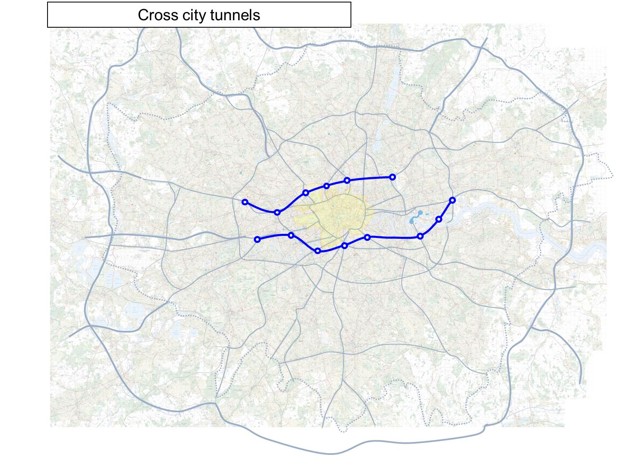
The new proposed tunnels, with a combined length of about 26 miles, are shown in this map below in blue:
These two main east-west tunnels would be accomanied by 9 new 'fly-unders' at various points throughout London. A better map of all of this can be found here:
http://www.theguardian.com/uk-news/2016/feb/04/boris-johnson-london-road-tunnels-congestion-air-quality
The northern tunnel - the Northern Cross City Corridor -would be 18km in length, connecting at Park Royal to the west with the A40 - the main highway for Birmingham, Manchester and Liverpool, and to the east in Hackney Wick with the A12 towards Dover.
The southern tunnel would be 25km in length, tunnel would connect the A4 in Chiswick to the A13 in Beckton.
Mayor Johnson stated that the tunnels could cut congestion in central London by 20%, and be funded by tolls.
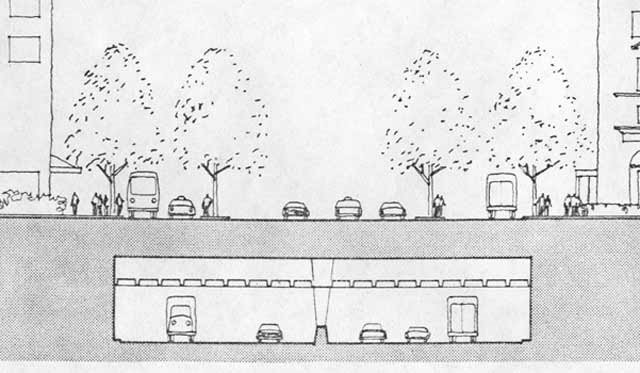
The map above has been accompanied by a artists rendering of the redeveloped space atop.
The space atop these tunnels and fly-unders would feature new development. Such real estate development, plus tolls are being promoted as ideas to pay for the tunnels' construction.
Tuesday, February 2, 2016
PIRG's Continuing Reactionary Opposition to Freeway Network Expansion
Places ideology over needs via opposing seriously needed road projects,
such as widening I-95 in Connecticut, and a Tunnel in Pasadena, California
to establish a continuous I-710
http://uspirg.org/reports/usp/highway-boondoggles-2
The report lists a series of highway projects which it deems as questionable, based more upon ideology against any highway capacity expansion projects than an understanding of local and regional needs.
Two particularly egregious examples of this is their opposition to widening I-95 in Connecticut with one additional lane in each direction from its existing 3 lanes in each direction configuration that it was originally built with during the 1950s, and to the idea of a tunnel to eliminate the I-710 gap in Pasadena, California as the least locally impactive method, following the past rejection of conventions surface and cut and cover designs.
About Connecticut I-95
Connecticut I-95 is that state's sole grade separated open to mixed traffic highway in the densely populated 20 mile wide band along the coastline along the Long Island Sound, with the nearest such parallel highway I-84 being some 20 miles inland, with the 2 lane per direction Merit Parkway (closed to trucks and commercial traffic) some 4 miles or so inland the sole such other grade separated highway option between, and is paralleled by the Northeastern railroad corridor that carries rail cars from New York to Boston.
I-84 would be the physically easiest to widen, but is the furthest from the densely populated coastal area.
The Merit Parkway is significantly closer to I-95, but is politically difficult to widen owing largely to its iconic bridges which would have to be realistically either reconstructed or twinned, and would still not be suitable for large trucks.
The parallel railroad should be upgraded to permit improved rail service.
But I-95 should still be widened.
Favoring one mode of transport should not mean neglecting capacity improvements to the other. Highway and rail can relive each other to varying degrees more than they can altogether substitute for one another. Rail is more adaptable to absorbing longer distance trips, while highways are more suited to many other trips owing to the time savings of direct door to door service. Expanding both provides for future growth and increased human activity within a given developed area thus somewhat relieving pressures to expand development into more pastoral rural areas.
I-95 in Connecticut should ideally it should be 12 lanes with a 3/3/3/3 or so separate carriageway configuration, akin to that of much of the New Jersey Turnpike, at least from the New York line to past New Haven, as it would accept and distribute traffic to the sole east-west interstate highway just south of the N.Y. line in Westchester County (and conceivably from a bridge and or tunnel crossing of the Long Island Sound to existing Route 135 in Long Island)- I-287.
As such a "duel barrel" configuration would have relatively high right of way requirements, a more feasible option would be widening it from a 3/3 to a 4/4 or 5/5 configuration, designed with a long term staging plan for parallel carriageways, with segments built in spots where more needed and more physically practical in an outboard configuration, designed to be later made continuous with added segments that would tuck underground beneath the existing carriageways to reduce local impacts. Such a staging would be financially more practical, with the design including the road substructure to permit the later excavation of the underground segments without having to tear out the road.
To further reduce impacts, portions of this widened I-95 should be designed to accommodate various decked segments, with local overpasses made wider to include better pedestrian and bicycling connections, and with some provisions for future air rights development. Perhaps certain elevated I-95 segments, as that in New Haven could be reviewed for reconstruction in a fashion via enclosures through new buildings, with access ramps reconstructed via a center rather than a side loader configuration for better accommodating vehicular and local pedestrian traffic.
To help relieve Connecticut I-95, particularly from I-287 in New York to past New Haven, the eastern portion of Westchester I-287 should be widened to at least a 5/5 configuration to I-684, which itself should be widened from 3 to 5 lanes in each direction.
About CT I-95
http://www.nycroads.com/roads/ct-turnpike/
About Pasadena I-710
This is a longstanding gap in the highway network in need of filling.
It initially resulted form the physical reality that the area of Pasadena, California is largely older more historically significant architecture built well before the mass freeway era, and from poor planning decisions to permit mass real estate development construction in a band to the west, particularly without any consideration there for the idea of doing such atop a cut and cover-box tunneled freeway.
Past plans for a conventional surface cut freeway through the long established Pasadena residential neighborhoods would die political deaths owing to popular revulsion over the demolition and/or moving requirements. Likewise with later plans for a tunnel via the cut and cover method for that would have likewise involved surface displacement though without such permanently, particularly if the existing buildings were replaced or re-situated atop.
Subsequently, the official planning has turned to completing the I-710 missing link via a tunnel that would be moled (IOW drilled or bored) hence not disrupting the surface for almost all of its length, with the exceptions being for its relatively brief cut and cover transition segments at each of its ends, and for any ventilation components.
Current planning is for either one or two tunnel tubes, each with 2 levels, each with 2 lanes and a shoulder, providing a total of 4 or 8 lanes in total.
The 710 Tunnel project is a vitally important project for Pasadena and for the Greater Los Angeles area, for providing local relief for 710 traffic that must now detour to local streets or to parallel regional freeways as I-5, 170/101, and I-405. It would be about 4.9 miles long, connecting freeway stubs each with 3 or 4 lanes per direction. It is estimated to have construction costs of $3.2 to $5.6 billion, and would receive funding from tolls of about $15 for trucks and $5 for most other automobiles while providing savings in time as a relatively continuous high speed route.
LA's north-south freeways are particularly badly congested largely owing to the east-west mountains to the north separating LA from the San Fernando Valley, blocking the construction of capacious parallel routes via the local street grid.
A continuous 710 is particularly important for the port of Long Beach, with 710 already a major truck route.
LA's transportation problems also stem from a lack of a comprehensive passenger rail network, caused by the foolish decision to rip out its rail car transit system during the mid 1900s. And 710 completion opponents may well be right in their prescription for various additions to the region's sorely in need of expanding rail transit system. But they are wrong in outright opposing the 710 completion project for a drilled tunnel link, and would be better in asking for a broad transportation planning vision for rail and highways, perhaps one via splitting the 710 project into stages with the initial construction of a single double decked tunnel tube with the extra funds diverted to the transit projects before the future construction of an addition tube or tubes.
Perhaps there might be better economy to replace the double-decked 2x2 tube design with a larger diameter accommodating a 2x3 lane configuration? Or perhaps one featuring the former to accommodate trucks, accompanied with a lower height version of the latter for accommodating most other vehicles? Such would provide a total of 10 lanes with 4 for trucks and 6 for smaller vehicles, and should be evaluated together with options for staging either 2x2 or 2x3 double level tunnels so staged to ultimately provide 2 or more separate tubes.
With the LA region so starved for north-south cross mountain road capacity, throwing away any capacity for future additions, whether via highway or via railway should be viewed as criminal.
PIRG would do so much better by eschewing its reactionary ideological opposition to future highway capacity expansion to a more balance view that would instead debate how projects should be staged, permitting some highway expansion together with rail transit additions, rather than simply the latter.
Likewise, various DOTS need to include the idea of future staging into their basic designs allowing future capacity additions with minimal demolition of existing construction. For instance, the recent I-405 widening project should have been designed to accommodate future capacity additions, if not for continuous outboard or elevated carriageways, should have taken advantage of any space for access into parallel tunnelways, either directly beneath the existing mainline with the necessary substructure to permit excavation beneath without having to rip out the road/and or for such as a moled tunnel. Consideration of such staging should likewise not reflect the narrow transit only ideology prevalent in PIRG, via not excluding designs to help facilitate adding a future transit line.
Pro I-710 Tunnel Site
http://www.710coalition.com/
Anti I-710 Tunnel Site
http://www.no710.com/
Wikipedia I-710 article
https://en.wikipedia.org/wiki/Interstate_710
Friday, May 16, 2008
Fisker Karma Serial Hybrid


Fisker Karma- plug in serial hybrid electric drive-train by Quantum Technologies: uses its combustion engine solely for charging its lithium-ion batteries, avoiding the complexities of clutching-transmissions of standard hybrids. This would be the 1st serial hybrid within the US for an automobile: diesel locomotives in use for decades are serial hybrids, given that electric is superior to combustion for propulsion, e.g. superior torque curve. Has plug in capability to allow charging from the grid and/or a solar panel kit for a 50 mile range before resorting to a small 4 cylinder engine for battery charging; includes regenerative ability to recover energy lost to braking.

Has an optional roof solar panel for stationary air conditioning and trickle charging its batteries.
Demonstrates human ingenuity to preserve mobility to the chagrin of the new medievalists/neo feudalists who presume that the "profane" will abandon private automobiles for slow street cars (trolleys) so that the elites have more room upon the existing roads for themselves.
Is shown as a 4 door pillarless -- no "B" post -- "hardtop": a body style not produced in the United States of America since the 1978 Chrysler New Yorker; however the prototype below undergoing testing alas shows a "B" pillar (look through its windshield), suggesting that they may be wimping out as Chrysler did with its 2008 Challenger, and GM with its 2009 Camaro.
Price: $80,000 - $100,000, which is not that much more than a 12 cylinder BMW sedan, and which will go down as the costs of the new technologies are amortized over a larger production.
Fisker Automotive Web Site
Quantum Technologies
Saturday, April 26, 2008
Harvard Defeats Yale!
the Harvard community seeks cosmopolitan solutions to actually reconcile human needs.


http://www.cityminustraffic.org/newsite/introduction.htm
http://www.cityminustraffic.org/fgt/model.html
Thursday, April 17, 2008
Thursday, February 28, 2008
Going Below- Big Roads Below

Going below for highway design is to place the highway below ground by any of a number of methods to ultimately preserve the land above for other uses, including:
open cut highways designed to be subsequently covered
I-71 Fort Washington Way, Cincinatti, Ohio
http://www.cincinnati-transit.net/fww.html
http://www.cincinnati-transit.net/fww-tunnel.html
http://www.chankrieger.com/frames/projects/streetscape/cinn/cinn.htm
cut and cover highways covered as a part of the same project that created the cut:
I-395 3rd Street Tunnel (1-95 Mall Tunnel), Washington, D.C., 3 blocks west of the U.S. Capitol Building
http://www.roadstothefuture.com/DC_Interstate_Fwy.html
I-93 Central Artery/Tunnel Project, Boston, Massachusetts
BAB 100, Berlin, Germany
"The plans to extend Berlin's inner motorway ring from Tempelhof to Neukölln date back to the 1960s. They failed because of the considerable strain this stretch, which was planned as an open section at that time, would have placed on the neighbouring residential areas. In 1987 a decision was taken in favour of the shortest and most purpose-specific option: a 1.7 kilometre tunnel."
http://www.stadtentwicklung.berlin.de/bauen/strassenbau/en/a100_vorhaben.shtml
Lefortovo area Tunnel of the 3rd Inner Ring Highway, Moscow, Russia
Illustration: Park-Covered I-93 Central Artery
http://www.massturnpike.com/about/images/arch_model.jpg
LANE COVE TUNNEL, Sydney, Austrialiaa key link in Sydney's orbital motorway network, connecting the Gore Hill Freeway with the M2. It will result in quicker journey times between the city and Sydney's north west. The project was approved by the Ministry for Planning in December 2002.
http://www.rta.nsw.gov.au/constructionmaintenance/downloads/lct_appro_brochure1.pdf
Bored tunnel, Around Paris, France
Versailles Tunnel


Single Level for Mixed Traffic with vertical clearance for trucks


Double Level for automobiles and vans under 2 meters in height
(2.55 verticle clearance)
3 lanes, @ 2.8 meter wide
A86 Motorway, Versailles, France
http://www.a86ouest.com/home/home.cfm
http://www.a86ouest.com/uk/projet/a86_ouest.cfm
http://www.cofiroute.fr/Uk/reseau/F_reseau.htm
"Located at an average of six kilometres from the Parisian ring road, the A86 motorway forms the second ring road around Greater Paris. The motorway is aimed to reduce the traffic on the local roads, to relieve the Parisian ring road and to encourage travelling between the different areas in the suburbs.
The A86 West is the missing link of the "greater ring road", and is underground. 80% of the 78 kms are already completed. "


Filtration of Vehicular Exhaust in Road Tunnels
Road tunnels, urban air pollution and filtration - the issues.
http://savewollicreek.8m.com/backnote.html
Electrostatic precipitation: Valuable for removing particulate matter.
Used in Norway, Japan and Australia
http://savewollicreek.8m.com/
New clean air legislation in Austrialia:
An Act to amend the Roads Act 1993 to require pollution filtration equipment to be installed and maintained that will remove particulate matter from air exiting the M5 East motorway tunnel, the proposed Lane Cove Tunnel and the proposed Cross City Tunnel.
http://www.parliament.nsw.gov.au/prod/parlment/NSWBills.nsf/1484fd8a7ada6a26ca25691c001793ed/4ad7c838f7b2318dca256b7a001e28d5?OpenDocument
Valuable for removing oxides of nitrogen and sulfate dioxide
Under experiential use in Norway, Austria and Japan is a gas purification system to remove from the air oxides of nitrogen as well as sulfur dioxide. Far from increasing costs, the Norwegian experience suggests that if air-cleaning technologies are included in the design from the beginning the overall expenditure is reduced.
http://www.clovermoore.com/idx.htm?http://www.clovermoore.com/bligh/speeches/1999/991021-1.htm
http://groups.google.com/groups?q=urban+road+tunnel&hl=en&lr=&ie=UTF-8&oe=UTF-8&selm=1994May17.090652.22074%40mel.go.jp&rnum=1
Filtration equipped Tunnels: RX for reduced pollution
Road tunnels equipped with exhaust filtration would tend to reduce exhaust emissions into the general atmosphere by so diverting/accepting traffic, particularly if so providing regionally more direct routes, thereby accommodating greater human activity within a given developed region, and improving the economic competitiveness of older more built up, more pedestrian and transit friendly cities.
The use of filtration in new road tunnels has been advocated by environmentalist activist Bernard Saunders in the New York City Metropolitan region, for a new combined vehicular railway/highway tunnel for relocating the I-287 Cross Westchester Expressway underground
http://www.bh.com.au/m5east/index.htm
And for CO2:
http://cos-mobile.blogspot.com/2011/04/co2-capture-from-vehicular-tunnels-for.html
Recycling Right of Ways and other existing swaths
|
| |
|
|
Avoiding Forseable Conflicts
Introduction
Foreseeable conflicts between transportation needs and real estate development occur when government entities involved with planning matters fail to consider long term needs when they approve real estate projects so situated to significantly raise the costs of future transportation projects, with forseeability be greater for those involving technologies already in widespread use. Such situations include real estate development placed directly in the path of a new or improved roadway, and those placed close enough with a design that does not guard against increasing the costs of future transportation infrastructure construction, such as new structures placed alongside an existing retaining wall that would have to be shored up to replace the existing retaining wall.
Principles
- Greater Mixed Use of Land via Cataloging existing corridors and right of ways, including adjacent properties.
- Acknowledging Long Term Needs and Existing and Foreseeable Future Technologies
- Ensuring that real estate development respect transportation corridor setbacks for maximizing its potential via not placing relatively expensive structures too close, hence minimizing/avoiding future conflicts, such as the demolition of apartments.
- Leaving room to facilitate future transportation infrastructure construction with less disruption and lower cost, for instance leaving space to construct new slurry walls designed for decking over a roadway, along with some capacity addition, including better ramps and additional mainline lanes at traditional chock points for reducing congestion.
- Long Term Planning with more evolutionary and modular Designs
- Greater "bang for buck" with design consideration for future improvements consolidating and reducing costs per benifit.
Saturday, January 5, 2008
Build a Sandpoint, Idaho Tunnel
The group, which promotes the concept of putting portions of the highway beneath the city instead of in the creek, formally asked ITD's director and chairman of the Idaho Transportation Board in April to acknowledge that an objective alternatives analysis is compulsory and needs to be redone with a more transparent public review process. More ...This is a proposal to tunnel a highway beneath a city, as an environmentally preferable alternative to a surface road around a city's waterfront.

"Tunnels of this size, type and depth are quite common, and have been successfully constructed in many developed areas around the world," Stephen Mauss, vice president of Hatch Mott McDonald, said in a July 19 letter to Potter.
Hatch Mott McDonald has constructed some 1,500 miles of tunnel here and abroad, including the tunnel beneath the Detroit River that links the U.S. and Canada and parts of the famed London Underground.
Under the proposal, through-town traffic entering Sandpoint from the Long Bridge would descend below ground near the intersection of Superior Street and First Avenue. Traffic would emerge from the 2,250-foot tunnel near the city's former high school at Pine Street and Euclid Avenue, well within striking distance of U.S. Highway 2. More ...
City of Sandpoint IdahoCitizens for a Sandpoint Tunnel
Monday, December 3, 2007
Build a Cross Sound Tunnel
connecting I-287 with Route 135
Suggested Tunnel Configuration for I-287 Cross Sound Tunnel connecting Westchester County and Long Island, N.Y.
This would connect existing I-287 with Route 135 in Long Island.

It would be drilled over 100 feet beneath the underwater surface.Is being proposed by Polimeri International, a family owned Garden City, LI based development company.
It would be built with private funds, and charge a toll of $25 for passenger automobiles and an upwards of $100 for trucks.
It would be a useful evacuation route- a concept that the government has paid lip service.
N.Y. State Senator Carl Marcellino (R- Syosset) has announced hearings to be held on this proposal.


Daily News article
The Cross Sound Link Project
Saturday, November 3, 2007
Build a Cross Brooklyn Tunnel

From NYCROADSby Steve Anderson
| | |||||||||||||||||||||||||||||
| |
| ||||||||||||||||||||||||||||
Adopted from misc.transport.road
If New York City planning were more comprehensive with pursuing environmentally advanced designs for projects combining highways and rail, the discussion for this much needed Cross Bay Rail Tunnel to Brooklyn would include a vehicular link to New Jersey, with an eastern extension across Brooklyn to Kennedy Airport.Cross Brooklyn Expressway right of way tour- Old NYC
Like the Cross Brooklyn Expressway proposals of the 1960's, this would employ the right of way of the LIRR freight tracks. Unlike these earlier proposals, this new highway would be designed to not tower over neighborhoods, nor take lengthy swaths from existing neighborhoods, nor increase localized air pollution, nor even be something that could accurately be said as dividing Brooklyn locally. Rather than building a high viaduct over the railroad, or a below ground roadway lined with new buildings (at the expense of homes), build this Cross Brooklyn Expressway as an encased, multi-level, multi-model road tunnel with electrostatic precipitator filtration technology, built beneath a new linear park for much of its length.
This railroad corridor is wide at its western segment, approximately 250 feet wide with a single rail track, and its eastern segment traverses vast industrial areas. In contrast, the middle segment is only about 80 feet wide, and is immediately abutted by residential areas that may not permit widening. Indeed, this width is too narrow for a conventional expressway layout, thus requiring a multi-level underground facility. This would perhaps entail three separate decks, one deck for expanded passenger and freight rail service, and two decks for each expressway carriageway.
A full underground segment for this narrow middle segment, and the area along Linden Boulevard would be required for noise abatement.
The project should connect directly to a new Cross Harbor Railway/Highway Tunnel to I-78 in New Jersey, with new parallel roadways to at least the New Jersey Turnpike. Such a tunnel is currently planned, inexplicitly only with rail.
It would be perhaps the nation's most needed new evacuation route from a major metropolitan area, with the greatest re-use of existing industrialized right of way.
Cross Harbor - Cross Brooklyn Tunnel (non-multi-model rail only version)
Friday, October 12, 2007
Whatever happened to the idea of additional evacuation routes?
Shortly after the events of September 11, 2001, there was talk about constructing additional evacuation routes within the U.S. to better serve the evacuation for major metropolitan areas in a future emergency event.Yet within all of the 100s of billions of $$ spent since on the war in Iraq and with over-sightless surveilling the general public, there is nothing for new evacuation routes- particularly from such metropolises as Washington, D.C., and New York City/Long Island.
Logical projects would include:
I-287 Long Island Sound Bridge/Tunnel, either a full tunnel, or a bridge with tunnel (cut and cover box with full lanes and shoulders to mitigate the highway at the shore areas) to a Route 135 re-signed and improved as I-287
I-78 Cross Harbor-Brooklyn Highway-Railway Tunnel towards JFK Airport , preferably with an eastern extension along the Sunrise Highway corridor
Lincoln Tunnel 4th Tube
Midtown Manhattan 3rd Tube
Holland Tunnel Parallel Tubes
Northern and Eastern Washington, D.C. radial highways, in particular, the I-95 Grand Arc Mall Tunnel
Homeland Security Goal Better Served by Reviving I-70S through NW Washington DC- Mark Robinowitz
Thursday, July 26, 2007
Thinking Over the Box With Existing Right of Way
July 15, 2007
Op-Ed Contributors
Think Over the Box
By TED BALAKER and SAM STALEY
Los Angeles
AMID the debates — and the looming deadline — over Mayor
Michael Bloomberg’s congestion pricing plans for the city, one
recent traffic measure has caused little uproar: increased
fines ($115) for drivers who block the box. Indeed, many
New Yorkers support the mayor’s plan, which means that not
just regular police officers, but also the city’s more
than 2,800 traffic agents have the authority to hand out
tickets for an infraction known as blocking the box. And why
not? Few things enrage travelers more than the driver who
blocks the intersection, intensifying the already suffocating
traffic congestion.
But the truth is that while this plan may satisfy revenge
fantasies and increase city coffers, it won’t loosen gridlock’s
grip. It may even tighten it.
Blocking the box isn’t a law enforcement issue that
Mayor Bloomberg can address by simply having traffic agents
mete out punishment. It’s a traffic management issue that
represents political neglect of the road network. Drivers
aren’t letting their cars sit in the cross hairs of oncoming
traffic out of spite. They don’t relish the cursing, honking
and fist shaking aimed at them. Like everyone else in the
standstill, they’d prefer to be moving. But there’s just
nowhere to go.
Much of Manhattan’s congestion stems from vehicles passing
through the island on their way to destinations outside or
on the outskirts of the borough. These travelers would love
to bypass most or all of Manhattan, but the roadway network
won’t allow it. Instead it crams motorists together, turning
crosstown travelers into box blockers.
So, here’s the question: If straphangers can choose between
local and express service, why can’t motorists? In cities all
over the world and even in the United States, drivers can choose
to drive up and over intersections on humps called queue
jumpers, or they can duck under intersections through short
tunnels.
Queue jumpers and tunnels could make for a good fit in many
spots throughout New York because they operate within existing
rights of way. They can also be configured for many different
types of roads, from two-lanes on a one-way street (sending
one lane over the intersection) to streets with six or more
lanes.
Just take a look at how effective the Murray Hill Tunnel is
at bypassing traffic. The tunnel, which carries two lanes of
car traffic from East 33rd Street to East 41st Street, is a
great way to avoid the congestion of Park Avenue. Now imagine
more of these tunnels and some well-placed queue jumpers and
soon you’re traveling across town, dodging red lights.
Cities like Paris, Sydney, Melbourne, Tokyo and even
Tampa, Fla., have upgraded beyond queue jumpers to provide
longer under- and aboveground motorways. Granted, much of
the metropolitan region is packed with subway and train
tunnels and other utilities, but elevated facilities need
only airspace, and wide swaths of subterranean space
remain uncluttered.
Consider the western edge of Manhattan, where there are
no serious underground obstructions from the Battery to
the George Washington Bridge. Various east-west streets
are also free of subway tunnels. In the book “Street Smart,”
one contributor, Peter Samuel, makes a sensible suggestion:
construct a truck-only tunnel that would take many
lane-cloggers off surface streets. “It would feed a
north-south truckway spine along the west side of Manhattan,
with short east-west spurs,” he writes.
Gridlock hasn’t grown fiercer because drivers have become
ruder and simply no longer care if they block the box.
Rather, clogged intersections represent a symptom of
congestion’s root cause: political neglect.
For decades, officials have failed to upgrade the road network
to keep up with a swelling population. Mayor Bloomberg has said
that the city will grow by 900,000 people by 2030; if this
neglect continues, it will generate even more gridlock. Over
the next 20 years city forecasters expect automobile traffic
to grow by 10 percent and freight traffic to increase major
transportation recommendations in the city’s long-range plan,
not one would significantly increase the road system’s
capacity.
Mayor Bloomberg’s ironfisted approach to intersection blockers
not only allows an outdated roadway system to grow more
antiquated, it may also erode support for congestion pricing.
Cities like London and Stockholm have found it easier to sell
the public on congestion pricing when road projects are a part
of the deal, and New York should follow suit. After all, most
of those who would pay the $8 congestion toll — if the plan
is approved by Albany in time to meet tomorrow’s federal
deadline for a grant of about $500 million for the
program — aren’t out-of-towners, they’re the mayor’s own
constituents.
As we await news from Albany, many remain suspicious of
congestion pricing, and they won’t take kindly to additional
measures that cast drivers as scapegoats. Promising to devote
some congestion pricing money to building queue jumpers may
win over fence-sitting motorists, not to mention bus riders
who would enjoy bona fide express service.
Ted Balaker, a fellow at the Reason Foundation, and
Sam Staley, the director of the organization’ s urban and
land use policy, are the authors of “The Road More Traveled:
Why the Congestion Crisis Matters More Than You Think, and
What We Can Do About It.”
Copyright 2007 The New York Times Company
http://www.nytimes.com/2007/07/15/opinion/nyregionopinions/15CIbakalar.html?ex=1185595200&en=53fe13b2c65f78f4&ei=5070

Truck (Interstate Highway design standard) Tunnel
under existing right if way
(un-built Washington, D.C. I-66 K Street Tunnel)
Its' east-west spurs would logically include some variant of the underground proposals for at least a portion of the un-built Midtown Manhattan Expressway; similarly it could include an underground replacement for the un-built Lower Manhattan Expressway via a Canal Road Bypass Tunnel drilled beneath historic So Ho.
Logical additions would include a 4th tube for the Lincoln Tunnel, and at least a pair of new, modern specification 2 lane tubes paralleling the Holland Tunnel.
Regionally, it should be accompanied by the Gowanus Tunnel Project (with a tunneled extension north-easterly to bypass the Promenade), along with a Cross Harbor-Brooklyn Highway-Railway Tunnel from I-78 in New Jersey to the Conduit Avenue corridor (with Interboro spur), providing a valuable evacuation route from Long Island.